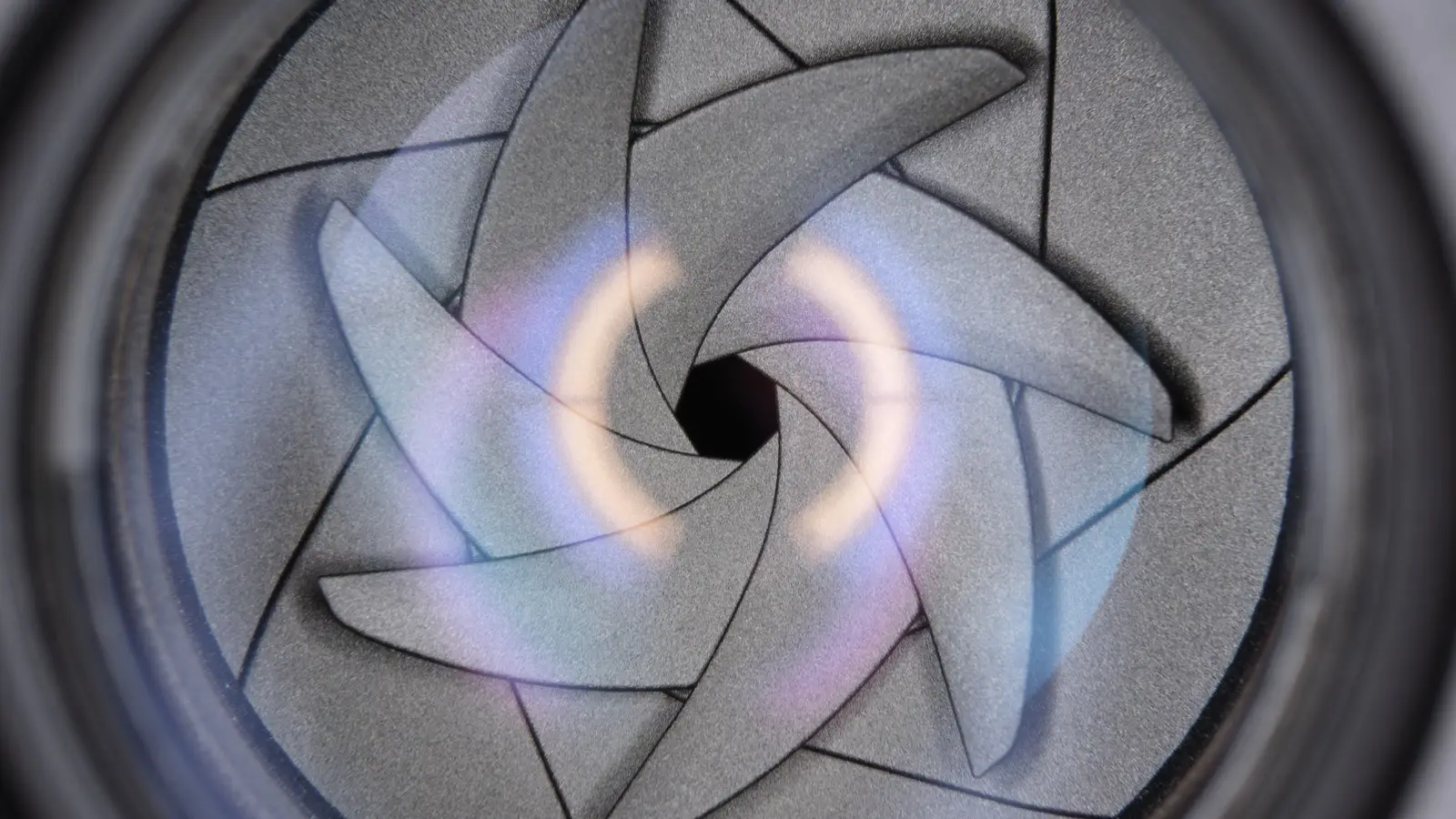
Aperture is the opening in your lens that lets light reach the camera sensor. It is measured in f-stops such as f/2.8, f/5.6 and f/8, and a lower number means a wider opening. Aperture changes how bright the picture is and how much of the scene looks sharp, so it is one of the first settings worth understanding.
The short version
- Aperture is the lens opening. A lower f-number (f/1.8) is a wider opening; a higher one (f/11) is narrower.
- A wider opening lets in more light and blurs the background more.
- A narrower opening lets in less light and keeps more of the scene sharp.
- Each full stop doubles or halves the light, so you trade aperture against shutter speed and ISO.
- Most lenses are sharpest a couple of stops down from their widest setting, not at the widest or the smallest.
What the f-number means
Nikon describes aperture as the opening in your lens that allows light to pass through to the sensor. It is measured in f-stops, and Nikon's rule is that the lower the number, the larger the opening and the more light gets in. The higher the number, the smaller the opening and the less light.
The numbers look odd, but the pattern is simple. The usual full-stop run, as Nikon lists it, is 1.4, 2, 2.8, 4, 5.6, 8, 11 and 16. Wikipedia's f-number article explains that each stop marks a halving of the light from the previous one, and that each added stop means a factor of two.
Say you move from f/2.8 to f/4. That is one stop, so you get half the light. Move from f/2.8 to f/5.6 and you are two stops down, so you get a quarter of it.
Depth of field and bokeh
Depth of field is the range of distance in a scene that looks sharp, according to Nikon. A wide aperture (a low f-number) gives a shallow depth of field. A narrow aperture (a high f-number) gives a deep one.
Shallow depth of field blurs the background which is why it is used so much in portraits.
Deep depth of field keeps detail across the whole frame, which landscape photographers use. The blurred look of those out-of-focus areas is often called bokeh. Wikipedia defines it as the aesthetic quality of the blur in out-of-focus parts of an image.
In practice, Nikon suggests a large aperture such as f/2.8 for classic portraits, a small one such as f/8 or f/11 for landscapes, and a mid-range setting such as f/5.6 when you want something in between.
For that middle case, Nikon advises taking a test frame and zooming in on the camera's screen to check the result.
The light, shutter speed and ISO trade-off
Aperture is one of three settings that control exposure, along with shutter speed and ISO. They are linked. Nikon says a low f-stop lets more light in, so the shutter does not need to stay open as long, which means a faster shutter speed. A high f-stop means the shutter needs to stay open longer.
Because each full stop is a factor of two, the swaps are easy to count.
By our arithmetic, opening up one stop lets you double your shutter speed (say 1/125 to 1/250) for the same exposure. In dim light you have three levers: open the aperture, slow the shutter, or raise the ISO. Which one you give up depends on the picture you want.
In aperture priority mode you choose the f-number and the camera picks the shutter speed. Nikon says that in manual or aperture priority modes, changing the aperture lets you tune exposure while keeping control of depth of field.
What the lens barrel tells you
Every lens has a widest aperture. Nikon says its lenses list it on the barrel. A zoom marked f/3.5-5.6 has a widest opening of f/3.5 at one end of the zoom range and f/5.6 at the other. A zoom that shows a single number holds its widest aperture across the whole zoom range.
| Lens | Widest aperture | Light vs. the other lens |
|---|---|---|
| Prime | f/1.8 | About 4.9 times as much light as f/4 |
| Zoom | f/4 | About one fifth as much light as f/1.8 |
The ratio is simple arithmetic on the f-numbers: (4 ÷ 1.8) squared is about 4.9, or a bit more than two stops. In practice an f/1.8 prime lets you use a faster shutter or a lower ISO in dim light and gives a shallower depth of field. An f/4 zoom needs more light to get the same shutter speed.
Phone apertures
Phone cameras are described the same way, with an f-number for each lens. Apple lists the iPhone 17 Pro's main camera at ƒ/1.78, the ultra wide at ƒ/2.2 and the telephoto at ƒ/2.8. For the base iPhone 17, Apple lists ƒ/1.6 for the main camera and ƒ/2.2 for the ultra wide.
Apple's spec pages list one aperture per camera. The same rule still applies: the lower the number, the more light the lens gathers. Check your own phone's spec page for its values.
The sharpest aperture
The widest setting is rarely the sharpest. Envato Tuts+ says a lens's sweet spot is generally two or three stops down from its maximum aperture. Its examples: for an f/1.4 lens the sweet spot normally falls between f/2.8 and f/4, and for an f/4 lens it falls between f/8 and f/11.
Closing down too far hurts. Adorama says the more you close the aperture, the less sharp the image becomes, a loss it calls lens diffraction. It adds that cameras with more megapixels can show diffraction at lower aperture settings than cameras with fewer.
For everyday shooting, that points to a simple habit. Use a wide aperture when you want blur or need light, a setting a couple of stops down from the widest when you want the sharpest image, and the smallest openings only when you need the depth of field. Every lens is a little different, so test yours if sharpness matters.
What we checked
We read the pages above on Nov. 29, 2026 (U.S. Eastern time). Quotes and numbers come from those pages, and the f/1.8 versus f/4 comparison is our own arithmetic. Phone values are for the iPhone 17 Pro and iPhone 17 only.
For lens care, see our guide to cleaning a camera lens and our camera coverage.